Sunday, November 17, 2013

Atlantis Hotel, Palm Jumeirah, Dubai


Atlantis Hotel, Palm Jumeirah, Dubai


     The Atlantis Hotel in Dubai is extraordinary.  But, even more astonishing is the island on which it’s built, the Palm Jumeirah.


     The Palm Jumeirah isn’t your typical exotic island with pristine white beaches and sparkling azure water.  This island is unique because it’s an incredibly large MAN-MADE, palm tree shaped island in the Arabian Gulf built from reclaimed sea sand.  Truly an architectural wonder and one of Dubai’s most famous landmarks known as the 8th Wonder of the World.  Prime real estate with every property having desirable beachfront access and water views - spectacular villas, condos and high rise apartments.


Location, location, location...  Who said you can’t make beach front property? 

YOU CAN, if you have enough money.  It’s so mind boggling to think that we were driving on an artificial island in the Arabian Gulf.  And, la ti da, we drove all the way to the Atlantis Hotel next to a chauffeur-driven silver Rolls Royce.   

     The Atlantis, which cost 1.5 billion dollars and opened in 2008, is located on the crescent of the Palm Jumeirah situated on 113 acres.  This ocean-themed resort features “Aquaventure” – a 42-acre waterpark with the “Zigguret” Centerpiece that touts a 27.5 metre-vertical drop and “The Lost Chambers” – where you can journey through a labyrinth of chambers to experience its fascinating underwater world with over 65,000 fish. 


     So, how much are you willing to pay to have your own personal aquarium view through a large window in your hotel suite just to watch the creatures of the sea?  The price tag is hefty.  Or, you can do what Bill and I did – just gaze at the aquatic view from one of the hotel’s many unique restaurants.   


      Ali Al Marzouqi, our Emirati friend, however, took his wife, three children and two nannies for an overnight stay at the five-star Atlantis.  They had a sea view and an aquarium view – a three-bedroom suite with an enormous window looking into the giant aquarium.  They loved the luxurious rooms and their children had a great time at the waterpark.  Can you afford $2,500 per night for a suite?  But, with 1,539 rooms, you could have a less expensive stay for about $800 - $1,000 per night.  [I don't think Bill and I will be staying overnight at the Atlantis Hotel anytime soon with those prices].


     The hotel lobby reminded me of a majestic European museum graced by a 10-meter high Dale Chihuly multi-colored abstract sculpture with over 3,000 pieces of hand blown glass surrounded by a round water feature or reflection pool which looked like a fountain with a glass centerpiece. 

     What was really ironic was that Bill and I had lived in Tacoma, Washington, Dale Chihuly’s hometown and the Museum of Glass.  His distinctive, imaginative and vibrant sculptures are known worldwide.  Several bars and restaurants in Tacoma had his early art work hanging or sitting on shelves, Chihuly having given them to his friends.  


     But this Chihuly glass sculpture had graceful trumpet figures and delicate, flowing shapes reminding me of the sea anemones with intense colors of turquoise, indigo, cerulean, sea green, yellow green, scarlet, yellow, red and orange glass of various sizes traveling up as far as you could see against a ceiling of gold leaf.  I remember feeling so small standing in front of it.  Everyone wanted to capture their own image in front of this unique glass sculpture, so cameras were flashing all around us.


     The highlight of the hotel was the massive, open air aquarium inside the Atlantis.  Of all the aquariums I’ve seen, such as the Marineland in Florida, the Monterrey Aquarium, and in the Dubai Mall, this was my favorite.  I felt like I could reach out and touch the thousands of fish zipping by.  Watching over 65,000 fish, stingrays and other sea creatures swimming around the aquarium through several gigantic two-story viewing windows was such a treat.  There is also a dolphinarium with more than two dozen bottlenose dolphins flown in from the Solomon Islands. 


      You’re never far from a shopping experience in Dubai.  So, we strolled through the upscale boutiques on “The Avenues”, a 7500 sqm. retail and entertainment complex.  I did a lot of window shopping at Tiffany’s, Chopards, Harry Winston, Louis Vuitton, Hermes, Gucci and Jimmy Choo.  I just told myself that I already had enough shoes and handbags.  I also know the difference between ‘want’ and ‘need’.  So, I kept the Visa card in my wallet and just pressed my nose against the stores windows looking for something on sale!  Not a chance! 


Monday, July 30, 2012

Ramadan - No Food, No Water, No Fun!


Ramadan – No Food, No Water, No Fun!


Grand Mosque, Abu Dhabi


     Ramadan Kareem!    Blessed Ramadan! 


     We just returned from having an overpriced brunch at the InterContinental in Dubai  where we sat in a darkened room behind a wall of black drapes.  It’s Ramadan…  It’s frustrating for Westerners who like to eat three meals a day, especially for me because I don’t cook much so we eat out frequently and have food delivered.  Can’t do that during Ramadan.  


Atlantis Hotel on the Palm Jumeirah, Dubai


Jumeirah Beach Hotel, Dubai

InterContinental Hotel, Dubai


     Ramadan began on July 21, 2012.  A time of fasting and prayer.  Long, hot, sunny days of fasting from dawn to dusk.  Muslims abstain from all food, drinks, cigarettes and unclean thoughts every day from sunrise to sunset during the 30 days of Ramadan. 
   
     Life for Westerners in the Middle East during Ramadan was no picnic either!  Westerners cannot eat or even take a drink of water in front of someone of the Islamic faith as a sign of respect.

     My Arabic women friends always prepared for Ramadan by having their homes cleaned top to bottom.  They bought new clothes, new furniture, new linens and particularly, new kitchen and culinary items including dinnerware, serving pieces and glassware.  They looked forward to Ramadan all year long and began their preparations days in advance by cooking and freezing various foods. 
 
Abayahs for the Women

     Restaurants were not open during the day, except in five-star hotels where Western guests are served.  Temporary black drapes were hung on all windows and the main eating area was always screened off from the lobby, out of respect for those fasting.  Hotels and restaurants officially open in the evening for ‘Iftar’ – the meal at sunset to break the daily fast. 

     Muslims typically break their fast with a few dates and a glass of water after which they have a large Iftar meal.  They celebrate with their family and friends, often reading from the Quran.  Each day before dawn, Muslims observe a pre-fast meal called ‘Suhoor’ at about 4:30 am, then the first prayer of the day begins. 

     I was privileged to share many Iftar meals with my Arab friends and their families.  Wonderful occasions with happy people celebrating their faith.  I sat on Haifa’s dining room floor at her family’s villa surrounded by women only.  We shared traditional Arabic food and the ladies used their hands to eat.  They were kind enough to provide eating utensils for me, as well as a cushion to sit on because marble floors are very unforgiving, even covered with rugs.    


Siham's Family Villa, Dubai


Haifa's Villa

     My husband and I often went out for elaborate Iftar meals at swanky hotels and restaurants where festive Ramadan tents were constructed on either the rooftop dining area or on the extensive grounds.  They were filled to the brim every evening with people of all nationalities and religions enjoying traditional Arabic mezze consisting of lamb, chicken, dates, juices, grilled vegetables and sweets on long buffet tables.  


Shisha Pipes

     Men and women smoked fragrant shisha pipes after dinner.  During Ramadan, the sale of alcohol in most outlets was restricted to after dusk.  In addition, no live music or dancing was allowed, so nightclubs tend to close for the entire month.  Cinemas limited daytime screenings of films.   
    
     Government offices, businesses and schools shortened their work and school hours all across the Middle East to about five hours per day.  Not a bad work schedule.  But, it was really hard to get any business done because of the shorter times. 

     Restaurants, dry cleaners, stores, etc., were open until 11:00 pm or midnight after a long afternoon break when people rested or napped.  Restaurant wait staff that we knew didn’t get home until 3:00 or 4:00 am.  As the month goes on, many Muslims sleep all afternoon and stay up long into the night and early morning. 

Abu Dhabi

     Supermarkets were open and food was sold during the day, but you obviously can't eat in public.  I usually packed my lunch and a large water bottle so I could eat during the day at work.  However, I would close the door to my office to have lunch, for both privacy and out of respect to my Muslim co-workers. 

     Westerners were also asked to avoid strong fragrances if you work closely with anyone who is fasting because the olfactory senses are more sensitive on an empty stomach.  As the Ramadan month progresses, people who are fasting become very tired and cranky because of sleep deprivation and fewer meals. 

     Children are encouraged to fast during Ramadan for as long as they can, but if they become too hungry, food is allowed.  However, by puberty they must fast all day just like their parents.  Exemptions to fasting are pregnant women, travel, illness, older age and women who are breast feeding.  Those who are ill or traveling are obliged to make up the days missed later on.   


Quran on Wood Holder - Jumeirah Mosque


Grand Mosque, Abu Dhabi


   Eid Mubarak!

     Happy Eid!   


     At the end of Ramadan, there is a three-four day holiday called Eid-ul-Fitr, the Festivity of Breaking the Fast.  All businesses and schools are closed for Eid. 

     Conservative Muslims celebrate the end of Ramadan with a sacrificial lamb slaughtered in three parts:  one part for the needy or poor people; one part for your friends; and the last part for you and your family.  There are special slaughterhouses to have this done or some people do it themselves at home.  Feeding the poor and homeless is very important for all Muslims, particularly at the end of Ramadan.     

     My Arabic friends told me that they often visit the graves of loved ones on the morning of the last day of Ramadan before sunrise and take flowers and greenery.  They celebrate the lives of their deceased ones and pray to Muhammad the Prophet.  The Call to Prayer is heard five times a day throughout the city over all mosque loud speakers whether or not it is Ramadan.  Typically, men and women attend separate mosques, but most females pray at home.


Jumeirah Mosque, Dubai
     The timing of Ramadan is not fixed in terms of the western calendar, but each year it occurs about 11 days earlier than the previous year with the start date depending on the sighting of the moon. 

     Therefore, Islamic holidays are usually confirmed less than 24 hours in advance.  
   
     Most companies send emails to employees the day before notifying them of the confirmed holiday date.  

    I respect my Muslim friends for their faithful practice of fasting and praying during Ramadan.  I can barely manage to function if I miss breakfast, lunch or dinner, much less going without food or water for 10-12 hours every day for 30 days.  From my heart to their hearts, Peace to all of my Muslim friends during this holy month of Ramadan.     
Reply to:

Reply to barbara edwards


Friday, June 22, 2012

Sir Bani Yas Island


Sir Bani Yas Island, Abu Dhabi


    A true ‘Desert Island’ off the coast of Abu Dhabi.  Only one luxurious, intimate five-star hotel on the island for our romantic weekend.  Cheetahs, striped hyenas, Arabian oryxes, Arabian gazelles, sand gazelles, ostriches, giraffes...  The white hot desert, the sharp naked mountains, the cobalt blue Arabian Gulf and glittering white beaches...  All on a ‘Desert Island’.  Very restricted and utterly magical. 


An unusual, yet fascinating flight on an old Emirati Air Force C130 cargo plane which had been outfitted with seats.  No flight attendants, no beverage service, no pretzels or restrooms for the two-hour flight.  Our departure was even rather special as we flew out of Abu Dhabi’s private Executive Airport – no cameras or photographs allowed.  When was the last time your pilot opened the back of the plane as you taxied to a stop?  Felt like the blast of a huge furnace when the cargo door opened.   


    As we were cruising at a very low altitude over the Arabian Gulf, the crew invited some of us into the cockpit for the most spectacular view.  I felt like I could reach out to touch the clouds and the whitecaps below.  Looking at the Gulf from the pilot's perspective through the square windows which encircled the plane’s nose down to the floor was almost like flying the plane myself. 


    Cool moist towels, ice water, coffee, tea and an assortment of fruit and dates welcomed us upon our arrival at the Desert Island Resort and Spa.  A long, winding sandy road from the tiny airport landing strip on the north side of the property snaked around to the desert hotel which was the only structure on the southern coast of the island. 


    Kayaking through the quiet, peaceful mangroves, gliding across the calm water, looking at unusual birds and fish became my late afternoon activity.  I paddled a long, blue kayak along with three other guests and our guide.  No sounds, no cars, no honking horns, no airplanes and no talking.  Silence, total silence, except for the birds flying overhead.  What a difference that two-hour flight had made – Abu Dhabi chaos, traffic and noise vs. the solitude of this private island in the Arabian Gulf. 


 But, the landscape changed dramatically when Bill and I hopped into the safari Range Rover with the pop-up roof along with several others to enjoy the Nature and Wildlife Drive in the Wildlife Park.  What a scenic outing we had traversing the hills and sandy terrain on the island.  Incredible seeing all of the animals so close and personal.  An ostrich came right up to the jeep, stuck her head through the window and tried to snatch someone's Rolex because she likes shiny objects!  A cheetah prowled about 50 feet from the jeep and that was really frightening!  He was searching for his dinner.  Fortunately, we weren't on the menu.  


    The native Arabian Oryxes and Sand Gazelles were hauntingly beautiful standing tall and proud with long horns jutting from their heads.  Sharp, piercing eyes watched as we drove past, but they did not appear to be afraid.  They blended into the desert landscape with their soft tan, beige, dark caramel coloring. 


    The island is now a breeding reserve for some of the rarest gazelle and antelope species.  It’s a natural habitat for both indigenous and introduced wildlife with several thousand free-roaming animals native to the Arabian Peninsula on the island. 


    Sir Bani Yas Island was originally the private island of the late Sheikh Zayed Bin Sultan Al Nahyan, President of the United Arab Emirates, for nearly 30 years.  There are three private palaces on the island:  one for the Sheikh, one for the Sheikh’s wives and visiting women, and the third palace to entertain guests. 

    The island is one of the largest in the Emirate of Abu Dhabi and only recently, the first island to welcome tourists.  Desert Islands Resort and Spa by Anantara is the only hotel on the property with just 64 luxurious rooms.  Reservations are nearly impossible to obtain because it is booked over a year in advance and access to the island is strictly limited to hotel guests.  Transportation to the island is, of course, only by boat or plane.

    However, there is one other interesting and historic ‘property’ on the island.  Ruins of a 1,400-year-old monastery that is the only pre-Islamic Christian site in the region have been found.  It dates back to around 600 AD and was built by a community of 30 to 40 monks.  The monastery was established by pilgrims travelling from India. 

    The remains, which also include a church, chapel and tower, were unearthed in 1992 during an archaeological study.  Excavations will continue as visitors come to the site.  Unfortunately, we did not have an opportunity to visit the historic area.  But, you can read more about this monastery at: 


    I walked on soft, white beaches with crashing waves, hiked through a solitary desert, and enjoyed a private, desert island in the Arabian Gulf.  What a privilege and rare treat!  I continue to be amazed at the incredible natural landscapes that the UAE has to offer – tall, red sand dunes, brilliant beaches and an occasional green oasis.  The Middle East I know is not just sleek high-rise buildings, or glitz and glamour, but so much more. 

Friday, April 20, 2012

Camels and Camel Racing


Camels and Camel Racing


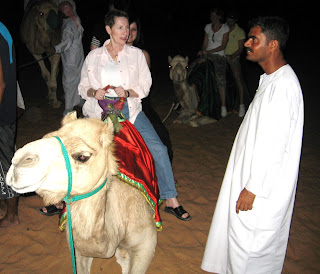
    My first camel ride was on my birthday during a Desert Safari with my husband.  The April moon was full and bright.  I remember that my camel had a strange, uneven loping gait as he walked in the sand.  He wore a muzzle over his nose and mouth so he couldn’t bite me.  However, the weirdest movements were when he got up from his kneeling position with me on his back and then again when his trainer had him get down at the end of the ride to let me off.  It felt like I was being pitched over his head and then thrown backwards. 

     I sat high off the ground on my very tall camel as we walked in the desert.  What I loved most though was the shadow that the camel and I cast on the sand dunes because of the full moon.  I felt like I was part of the Arabian Nights.  What a ride!  What a night! 

Barbara and Rebecca - Desert Safari, Dubai
  
    But, one of the most memorable experiences was going Dune Bashing, then visiting the Camel Farm in the desert on this same birthday Desert Safari.  Our driver, Ali, drove us out of Dubai into the desert, stopping at a service station to let air out of the SUV’s tires so we could drive in the deep, fine sand.  We finally went off-road into the dark red sand and started climbing up the dunes. 


    Driving up, up, up the sand dunes.  Then, at the top of the dune, Ali,  stopped and literally let the SUV slide sideways down the dune.  The dunes were much higher than I thought they would be, so our view was incredible each time we reached the top ridge.  Our driver would drive as fast as he could up, up, up and over the top of the dune with the SUV leaving the ground!  We were airborne!  Hold on tight!!!  We went up and down, dune after dune, several times, laughing so hard that we had tears rolling down our faces. 


     After the dune bashing, Ali drove to the camel farm.  We jumped out of the Range Rover literally moments after the birth of a camel that was born on my birthday!  We watched the mother camel as she cleaned her baby, nuzzled him, and encouraged him to stand.   He looked like he was dead because he wasn’t moving at all.  He was grey, very skinny, wobbly long neck and tiny body. 

Mama Camel and new baby camel on ground

    Finally, after about 45 minutes, the baby camel staggered onto his four unsteady, scrawny legs.  He fell over immediately, but his mama didn’t give up.  She continued to lie down beside him, licked him all over, sniffed him, and just took care of him.  After another 15 minutes, he was standing on his own and beginning to nurse his mother. 


     I loved the camel caretaker, Mohammed, who wore a red/white checkered headpiece and just seemed to belong to the desert.  He was very dark skinned, smiled a lot and was very proud of the mama camel and her new baby.  Our guide translated our conversation. 

    Mohammed said he would name the baby camel after me because he was born on my birthday!  I now have a camel named after me living in the desert outside of Dubai.

     Camels everywhere!  One hump or two: while living in the United Arab Emirates, I saw only the Dromedary camel or the Arabian camel, which is a large, even-toed ungulate with one hump on its back and is native to this country.  The two-hump camel or the Bactrian camel is not native to this part of the Arabian Gulf. 

    In Wisconsin, drivers often hit deer on the highways resulting in a lot of damage to our cars and the deer.  Unfortunately, in the UAE, every camel has an owner; so, if you hit a camel and are caught, you will most likely pay a large fine or go to jail.  Camels are usually fenced in the desert, but many roam freely along the roads.

Camels on road to Fujairah
    I learned that camels are raised for racing and for their beauty, which I found odd because I didn’t find them particularly pretty.  The Sheikhs own most of them with the average price of a camel being $100,000 to $1,000,000. 

    The former president of the UAE, Sheikh Zayed, endorsed camel racing because it provided work and financial support for the camel caretakers.  He owned a personal stable of about 14,000 camels and 9,000 workers for their upkeep.

    At a broad, sandy camel racetrack, camels stand in groups of four and five.  The sight of the huge beasts next to the trainers and handlers in their long white robes and headdresses contrasted sharply with the Dubai skyscrapers, which gleamed in the distance like a desert mirage. The lifting of the large, multi-strand barrier signified the beginning of the race.   

    Suddenly, the trainers leapt into waiting jeeps and sped off on a road parallel to the racetrack.  They left behind the handlers who clap and whistle, prompting the camels to start a clumsy gallop down the track as a training run for an upcoming race.  There are no riders perched on the camel’s humps.  Instead, the cylindrical robot jockeys are strapped to their saddles.

    However, there are still some kinks to work out.  For one, camels can be uncooperative.  During the training run, one camel – robot in tow – broke off from the pack and sprinted the wrong way down the track.  Several screaming handlers chased after the runaway camel, running barefoot in the sand.

   Camel racing season is from October through April on Thursdays and Fridays (their weekend) because the weather is now cooling down.  Two races are the norm, with the morning race beginning at 7:30 am and the afternoon race at 2:30 pm.

    I saw many more racetracks since first living in Abu Dhabi in 2004.  Now, the UAE has 15 racetracks across the country with spacious, well-kept stadiums for viewers. They are located on city outskirts, complete with rest tents, connecting roads, electricity, water, telephone lines, equipment for live television and radio broadcasts, a team of doctors, stand-by ambulances, and print transmission capabilities.

    Race distances vary between 4 to 10 kilometers and may include 15 to 70 camels or more. The camels run about 40 kilometers per hour and learn to race at two years of age.  Cameras are not permitted at the racetracks.  However, binoculars are necessary if you really want to see the races. 

    At the Nad al Sheba racetrack the morning races consist primarily of camels owned by Sheikhs, whereas the afternoon races are open to everyone. Sheikhs have been known to buy camels from owners who won the afternoon races, offering large sums of money to acquire the victorious camel.

    Currently, there are approximately 14,000 active racing camels in the UAE, which require large numbers of people to maintain them and keep them in top condition. The workers typically come from Pakistan and Oman.  Many trainers take their camels and race in other countries, such as Qatar, which have extended racing seasons beyond the UAE season.

    But, the most disturbing part of camel racing was the past practice of having young boys as camel jockeys.  These tiny little boys were only six or seven years old, weighing about 20 kilograms (44 pounds) so as not to be too heavy on the camel. The boys, usually from Pakistan and Bangladesh, were secured to the saddles with Velcro or tied on, often resulting in injuries to the little guys.  This practice was condemned by human rights groups and became an international issue, in addition to the trafficking of child jockeys.

    To address the problem, the UAE government issued a ban on child jockeys who are less than 15 years of age and weigh less than 45 kilos.  Camel jockeys must carry government issued ID cards, which can be acquired after passing examinations by specially appointed doctors to ensure that the child is of racing age and has not been taken from a foreign country by owners claiming to be parents.

Robot Jockey Riding in Camel Race

    The good news is that now ‘robot jockeys’ are transforming the traditional sport.  At the Gold Camel Sports Equipment Trading Shop on the edge of Dubai, the robot jockeys sell for about $500 each in a variety of colors.  A wireless receiver activates when the trainer presses a button on a plastic key chain.  Then the robot jockey’s single arm spins furiously, whipping the air and the camel with the riding crop.  The robot jockeys have also improved race times dramatically because the 10-pound robots are much lighter than the little boys are.

Robot Jockeys riding in the Camel Race
    Betting on the races is illegal in the UAE, but winners receive different prizes, many times in the form of luxury cars.  Very successful racing camels are worth millions of dollars and the most coveted prize is winning the King’s Cup in Dubai.

    Nad al Sheba Camel Racetrack, outside of Dubai, fills to the brim every Thursday and Friday during the winter months.  Camel races are also held in most of the other six emirates such as Sharjah, Ajman, Ras al-Khaimah, Fujairah, and Umm al-Qaiwain.

Camels at Global Village, Dubai
    How about an unusual camel event?  Camel Beauty Pageants!  I thought it was a joke the first time I heard it on the radio.  Then, I read about it in the newspaper. 

    Yes, the Camel Beauty Pageant is held each December during the Al Dhafrah Camel Festival in Abu Dhabi, when beautifully adorned camels strut their stuff for prize money, which in 2011 totaled Dhs 42 million ($11,444,141).  The first prizewinners in the native Asayel and Majahim categories (for dark-skinned Saudi Arabian camels) each took home Dhs 1 million ($272,479). 

    Go figure…  I have seen and heard everything now! 


Barbara riding camel at Global Village
Global Village, Dubai


Camels on Emirates Palace Beach, Abu Dhabi


Barbara and Rebecca riding a camel - Desert Safari


Camel grazing on the side of the road