Sunday, December 1, 2013

Middle Eastern Women


Middle Eastern Women


Global Village in Abu Dhabi


     Separation of the sexes!  No togetherness here, unless you are viewing your potential husband under the watchful eyes of your parents.  Women and men together?  Not unless you’re married to him.  No, rather women together shopping, eating, having coffee or going to school.  

     I taught English as a Second Language (ESL) in both Abu Dhabi and Dubai to a few mixed classes (adult men and women), but mainly to segregated groups.  Women only in one class, then men only in the next class.  Most grade schools and high schools are for girls only or boys only, and not ever on the same campus.  Only the international schools, the British or American schools are integrated.  However, the local Emiratis typically do not send their children to these schools, only the most progressive parents would do that.
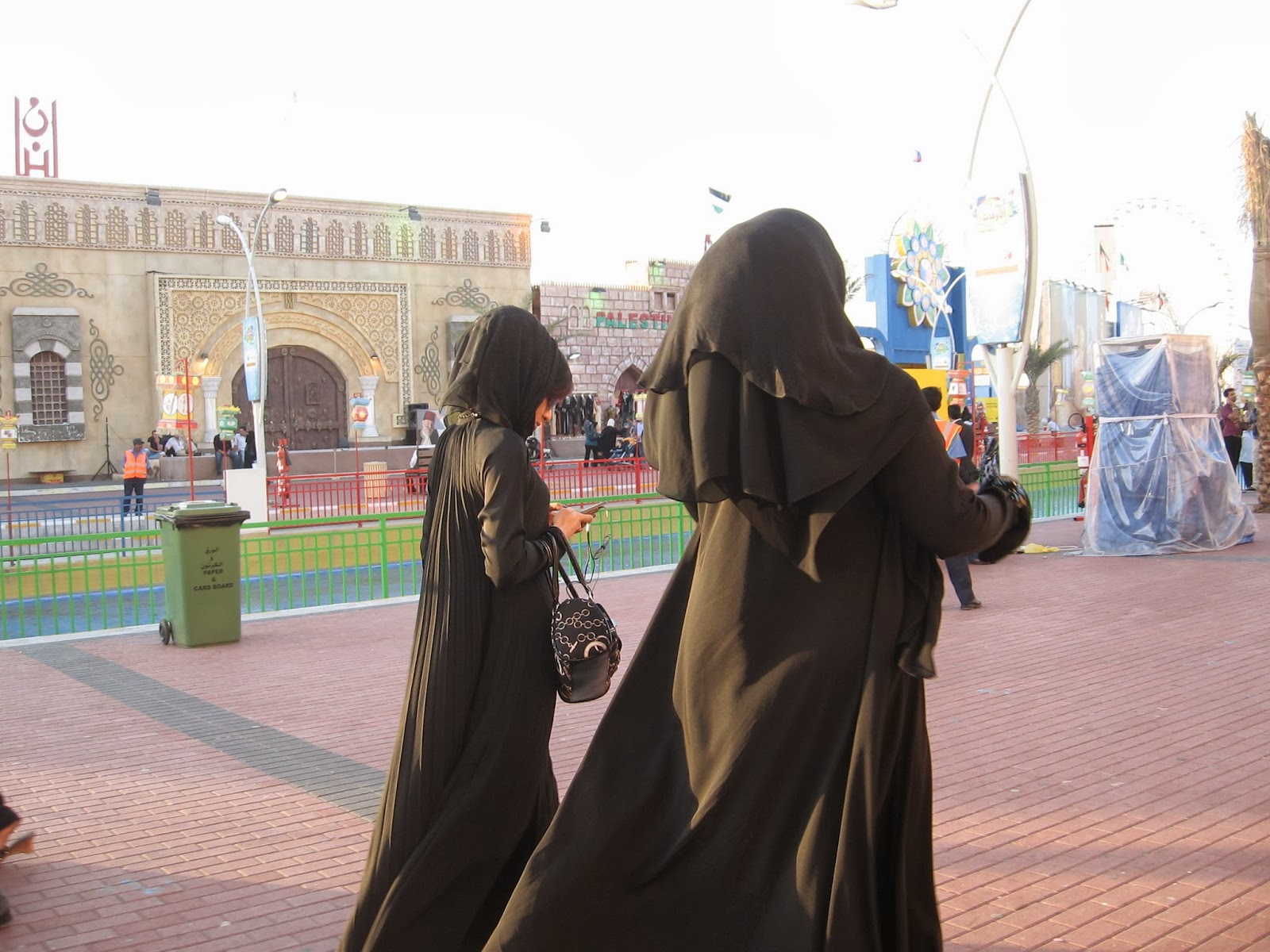
  

      There are ‘Women Only Beaches’, ‘Women’s Entrances’ at banks with all female employees and tellers, ‘Women’s Waiting Areas’ in most businesses and medical facilities.   

    Men are not allowed to even enter or walk through the areas where women are waiting or being served.        Women must have female physicians and, obviously, their OB/GYN is always a woman. 


     Bill was the Director of the Military Language Institute which was overseen by the Abu Dhabi government.  Therefore, our medical care was offered at the Military Hospital.  Of course, there was an enormous  ‘Women’s Only Entrance and Waiting Room’.  After you signed in and registered, they asked YOU to go to Medical Records and pick up your own medical records.  What?  So, both men and women stood in line together at the Medical Records Department.  
 

National Day, Dec. 2 in Dubai
     

    The Women’s Waiting Room was packed full of women in black abayas, hijabs or veils, nannies, crying babies, toddlers running everywhere, strollers obstructing the walkways and parked at inconvenient angles.  Waiting times varied from 30 minutes to two hours.    

   
     The Waiting Rooms contained very popular vending machines.  These Middle Eastern ladies loved Coke and Pepsi, salty chips and sweet goodies from the large machines.  Their children also carried bags of treats or chips around with them, and as most kids do, dropped lots on the floor.  TVs provided background noise to cell phones ringing, women speaking in Arabic and rowdy, loud children.   

     I think I had the youngest female OB/GYN in Abu Dhabi.  She was barely 23 years old and single.  I asked her how many years of medical school she had attended because she just looked so incredibly young.  She told me that she went to ‘college’ to study medicine and after four years, she was a doctor.  No additional training, no residency, no internship...  Just four years of medicine with, I hope, a concentration in obstetrics and gynecology.  And, after only a few visits, she invited me to her wedding for which she took off two months from work to prepare for the wedding and then for the month-long honeymoon, typically in Malaysia.   

Women on the Beach, Rotana Cove, Ras al Khaimah


    Wouldn’t you think that these women would be quite modest?   Well, the doctor’s office was the ‘changing room’, the ‘examining room’, and the room where the doctor talks with you and prescribes your medication.  Sometimes there was a curtain around the examining table, sometimes not.  So, I stripped my clothes off, put on the ugly blue gown with the opening in front and climbed upon the table with the crinkled paper alerting the OB/GYN that I was ready.  The doctor rolled her chair away her desk and came over to my side of the small, cold room to examine me.   

     Middle Eastern women marry very young because of the arranged marriages.  They begin having babies immediately, typically having several children.   Most couples hope to have a boy as their first born child.  If they have a girl first, there will most likely be several more pregnancies trying to have a son.

National Day, December 2 - Abu Dhabi


     Muslim women must also have female driving instructors.  There are women’s prayer rooms at all malls and businesses.  Most women pray at home rather than go to a mosque.  There is a separate prayer room for women in the Grand Mosque in Abu Dhabi, but most mosques typically don’t accommodate women during prayer times. 

     When I was the Executive Director of the American Business Group in Abu Dhabi, I had to have two separate large metal detectors at the entrance to the Gala Charity Ball at the Sheridan Hotel – one for men and the other for women.  We also had women security officers staffing the metal detectors and searching handbags. 


     How would you like to live under one big roof with your mother-in-law, father-in-law, sisters-in-law and brothers-in-law? 

    Getting married?  Pack your things and move in with your in-laws because that’s your new home.  Most young men and their new wives move into the groom’s home with his family after the wedding.  Now you’re really stuck with all of the females in the house, especially your lovely mother-in-law.  Hope she likes you and hope you like her!  You won’t be moving until the house is too full of couples and grandchildren.  Then, the oldest son and his family can move out.  But, you won’t be moving too far from your mother-in-law!


    The young Emirati bride can go out shopping with a group, visit her friends or go to the park with her relatives, but her mother-in-law usually knows where she is at all times and with whom.  She keeps a tight rein on the daughter-in-law’s activities and has informants everywhere.  Saving ‘face’ and acting appropriately at all times are important. 

     After the young couple begins having children or if the husband can afford a nice flat or villa, moving out could be an option.  But, being alone isn’t much of an option.  When the young bride has a baby, she moves back to her parents’ home to stay with her family for 40 days.  Her husband can come to visit her and the baby, but she won’t return to her husband’s family home until after the 40th night.  Again, a cultural tradition to support the new Mom and baby with family to support her. 

     How about the older Emirati women?  From what I’ve observed, women stop going out shopping, driving and to restaurants around 40-45 years old.  Women in the USA are in the prime of their lives during these years! Yet, in the UAE, I rarely saw Muslim women who were over 40, much less 50 or 60.  They have their daughters or daughters-in-law do the grocery shopping for the families.  I wonder who does their abaya and clothing shopping.   However, during our last stay in Dubai, things were changing slowly and I did see some older women out shopping.
     
       Occasionally, I would see a family with an older lady behind the screened section of a restaurant where privacy is a must.  Eating out is always a challenge because of their veils.  Women must either lift their veil to take each bite of food or be seated behind wood screens, curtains, in booths with doors or in an isolated family area in restaurants to remove their veil to eat.

     What about widows and divorcees?  They usually don’t remarry because there are few social occasions which would permit meeting or interacting with eligible men.  Also, most men, regardless of their age, want to marry young women who can have children.  So, widows or divorcees rarely go out in public nor are they introduced to men, unless a meeting is arranged. 

     The Emirati women who work are a bit more progressive and at least have the ability to have a conversation with a man who isn’t a family member.  But, I didn’t see many older women in the workplace.
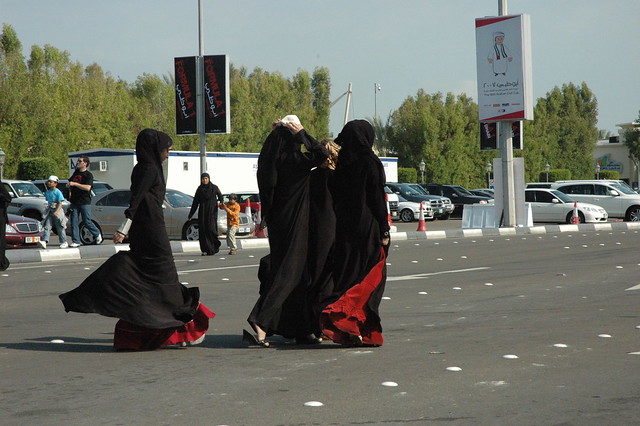


     I did see older women at hospitals, clinics and pharmacies, but, they were usually accompanied by their husband, son or daughter.  Going out alone would be the exception for an older woman. 


     As a Western woman, I was allowed to go to the front of the line at the post office.  However, this was the only place where I was afforded any privilege because I was a woman.  The first time I went to the post office, I took my place at the back of a long line of men.  Much to my surprise, the male postal employee motioned for me to come to the front of the line so he could wait on me ahead of the men.  I was confused by his summoning and asked if he really wanted me to go to the head of the line.  Yes, he did.  


     My choice of clothing was simple – conservative and appropriate.  I was not required to wear an abaya or a hijab over my hair.   However, young girls and teenagers recognize that their method of dressing is a part of their culture.  Abayas, hijabs, veils and sheylas are fancier than they were several years ago when I first lived in Abu Dhabi.  Now the black garments have beads, colorful embroidery, and intricate patterns on the cuffs, around the bottom of the abaya and sometimes down the front and back of the long dress.

Boat Ride at Global Village, Abu Dhabi
Day at the Beach in the Middle East
        
    My time in the Middle East was very special because I became friends with many local Emirati women through my teaching of English.  I was honored to be invited into their homes for meals with their families and invited to weddings with them.  We went out shopping and to lunch.  We had a lovely time talking about our children, husbands, clothes, shoes, movies, books, travel and losing weight.  They want the same things we do – a healthy, happy family, a rich husband, a good education for themselves and their children, a good job and they want to lose those last 10 pounds!


Sunday, November 17, 2013

Atlantis Hotel, Palm Jumeirah, Dubai


Atlantis Hotel, Palm Jumeirah, Dubai


     The Atlantis Hotel in Dubai is extraordinary.  But, even more astonishing is the island on which it’s built, the Palm Jumeirah.


     The Palm Jumeirah isn’t your typical exotic island with pristine white beaches and sparkling azure water.  This island is unique because it’s an incredibly large MAN-MADE, palm tree shaped island in the Arabian Gulf built from reclaimed sea sand.  Truly an architectural wonder and one of Dubai’s most famous landmarks known as the 8th Wonder of the World.  Prime real estate with every property having desirable beachfront access and water views - spectacular villas, condos and high rise apartments.


Location, location, location...  Who said you can’t make beach front property? 

YOU CAN, if you have enough money.  It’s so mind boggling to think that we were driving on an artificial island in the Arabian Gulf.  And, la ti da, we drove all the way to the Atlantis Hotel next to a chauffeur-driven silver Rolls Royce.   

     The Atlantis, which cost 1.5 billion dollars and opened in 2008, is located on the crescent of the Palm Jumeirah situated on 113 acres.  This ocean-themed resort features “Aquaventure” – a 42-acre waterpark with the “Zigguret” Centerpiece that touts a 27.5 metre-vertical drop and “The Lost Chambers” – where you can journey through a labyrinth of chambers to experience its fascinating underwater world with over 65,000 fish. 


     So, how much are you willing to pay to have your own personal aquarium view through a large window in your hotel suite just to watch the creatures of the sea?  The price tag is hefty.  Or, you can do what Bill and I did – just gaze at the aquatic view from one of the hotel’s many unique restaurants.   


      Ali Al Marzouqi, our Emirati friend, however, took his wife, three children and two nannies for an overnight stay at the five-star Atlantis.  They had a sea view and an aquarium view – a three-bedroom suite with an enormous window looking into the giant aquarium.  They loved the luxurious rooms and their children had a great time at the waterpark.  Can you afford $2,500 per night for a suite?  But, with 1,539 rooms, you could have a less expensive stay for about $800 - $1,000 per night.  [I don't think Bill and I will be staying overnight at the Atlantis Hotel anytime soon with those prices].


     The hotel lobby reminded me of a majestic European museum graced by a 10-meter high Dale Chihuly multi-colored abstract sculpture with over 3,000 pieces of hand blown glass surrounded by a round water feature or reflection pool which looked like a fountain with a glass centerpiece. 

     What was really ironic was that Bill and I had lived in Tacoma, Washington, Dale Chihuly’s hometown and the Museum of Glass.  His distinctive, imaginative and vibrant sculptures are known worldwide.  Several bars and restaurants in Tacoma had his early art work hanging or sitting on shelves, Chihuly having given them to his friends.  


     But this Chihuly glass sculpture had graceful trumpet figures and delicate, flowing shapes reminding me of the sea anemones with intense colors of turquoise, indigo, cerulean, sea green, yellow green, scarlet, yellow, red and orange glass of various sizes traveling up as far as you could see against a ceiling of gold leaf.  I remember feeling so small standing in front of it.  Everyone wanted to capture their own image in front of this unique glass sculpture, so cameras were flashing all around us.


     The highlight of the hotel was the massive, open air aquarium inside the Atlantis.  Of all the aquariums I’ve seen, such as the Marineland in Florida, the Monterrey Aquarium, and in the Dubai Mall, this was my favorite.  I felt like I could reach out and touch the thousands of fish zipping by.  Watching over 65,000 fish, stingrays and other sea creatures swimming around the aquarium through several gigantic two-story viewing windows was such a treat.  There is also a dolphinarium with more than two dozen bottlenose dolphins flown in from the Solomon Islands. 


      You’re never far from a shopping experience in Dubai.  So, we strolled through the upscale boutiques on “The Avenues”, a 7500 sqm. retail and entertainment complex.  I did a lot of window shopping at Tiffany’s, Chopards, Harry Winston, Louis Vuitton, Hermes, Gucci and Jimmy Choo.  I just told myself that I already had enough shoes and handbags.  I also know the difference between ‘want’ and ‘need’.  So, I kept the Visa card in my wallet and just pressed my nose against the stores windows looking for something on sale!  Not a chance! 


Monday, July 30, 2012

Ramadan - No Food, No Water, No Fun!


Ramadan – No Food, No Water, No Fun!


Grand Mosque, Abu Dhabi


     Ramadan Kareem!    Blessed Ramadan! 


     We just returned from having an overpriced brunch at the InterContinental in Dubai  where we sat in a darkened room behind a wall of black drapes.  It’s Ramadan…  It’s frustrating for Westerners who like to eat three meals a day, especially for me because I don’t cook much so we eat out frequently and have food delivered.  Can’t do that during Ramadan.  


Atlantis Hotel on the Palm Jumeirah, Dubai


Jumeirah Beach Hotel, Dubai

InterContinental Hotel, Dubai


     Ramadan began on July 21, 2012.  A time of fasting and prayer.  Long, hot, sunny days of fasting from dawn to dusk.  Muslims abstain from all food, drinks, cigarettes and unclean thoughts every day from sunrise to sunset during the 30 days of Ramadan. 
   
     Life for Westerners in the Middle East during Ramadan was no picnic either!  Westerners cannot eat or even take a drink of water in front of someone of the Islamic faith as a sign of respect.

     My Arabic women friends always prepared for Ramadan by having their homes cleaned top to bottom.  They bought new clothes, new furniture, new linens and particularly, new kitchen and culinary items including dinnerware, serving pieces and glassware.  They looked forward to Ramadan all year long and began their preparations days in advance by cooking and freezing various foods. 
 
Abayahs for the Women

     Restaurants were not open during the day, except in five-star hotels where Western guests are served.  Temporary black drapes were hung on all windows and the main eating area was always screened off from the lobby, out of respect for those fasting.  Hotels and restaurants officially open in the evening for ‘Iftar’ – the meal at sunset to break the daily fast. 

     Muslims typically break their fast with a few dates and a glass of water after which they have a large Iftar meal.  They celebrate with their family and friends, often reading from the Quran.  Each day before dawn, Muslims observe a pre-fast meal called ‘Suhoor’ at about 4:30 am, then the first prayer of the day begins. 

     I was privileged to share many Iftar meals with my Arab friends and their families.  Wonderful occasions with happy people celebrating their faith.  I sat on Haifa’s dining room floor at her family’s villa surrounded by women only.  We shared traditional Arabic food and the ladies used their hands to eat.  They were kind enough to provide eating utensils for me, as well as a cushion to sit on because marble floors are very unforgiving, even covered with rugs.    


Siham's Family Villa, Dubai


Haifa's Villa

     My husband and I often went out for elaborate Iftar meals at swanky hotels and restaurants where festive Ramadan tents were constructed on either the rooftop dining area or on the extensive grounds.  They were filled to the brim every evening with people of all nationalities and religions enjoying traditional Arabic mezze consisting of lamb, chicken, dates, juices, grilled vegetables and sweets on long buffet tables.  


Shisha Pipes

     Men and women smoked fragrant shisha pipes after dinner.  During Ramadan, the sale of alcohol in most outlets was restricted to after dusk.  In addition, no live music or dancing was allowed, so nightclubs tend to close for the entire month.  Cinemas limited daytime screenings of films.   
    
     Government offices, businesses and schools shortened their work and school hours all across the Middle East to about five hours per day.  Not a bad work schedule.  But, it was really hard to get any business done because of the shorter times. 

     Restaurants, dry cleaners, stores, etc., were open until 11:00 pm or midnight after a long afternoon break when people rested or napped.  Restaurant wait staff that we knew didn’t get home until 3:00 or 4:00 am.  As the month goes on, many Muslims sleep all afternoon and stay up long into the night and early morning. 

Abu Dhabi

     Supermarkets were open and food was sold during the day, but you obviously can't eat in public.  I usually packed my lunch and a large water bottle so I could eat during the day at work.  However, I would close the door to my office to have lunch, for both privacy and out of respect to my Muslim co-workers. 

     Westerners were also asked to avoid strong fragrances if you work closely with anyone who is fasting because the olfactory senses are more sensitive on an empty stomach.  As the Ramadan month progresses, people who are fasting become very tired and cranky because of sleep deprivation and fewer meals. 

     Children are encouraged to fast during Ramadan for as long as they can, but if they become too hungry, food is allowed.  However, by puberty they must fast all day just like their parents.  Exemptions to fasting are pregnant women, travel, illness, older age and women who are breast feeding.  Those who are ill or traveling are obliged to make up the days missed later on.   


Quran on Wood Holder - Jumeirah Mosque


Grand Mosque, Abu Dhabi


   Eid Mubarak!

     Happy Eid!   


     At the end of Ramadan, there is a three-four day holiday called Eid-ul-Fitr, the Festivity of Breaking the Fast.  All businesses and schools are closed for Eid. 

     Conservative Muslims celebrate the end of Ramadan with a sacrificial lamb slaughtered in three parts:  one part for the needy or poor people; one part for your friends; and the last part for you and your family.  There are special slaughterhouses to have this done or some people do it themselves at home.  Feeding the poor and homeless is very important for all Muslims, particularly at the end of Ramadan.     

     My Arabic friends told me that they often visit the graves of loved ones on the morning of the last day of Ramadan before sunrise and take flowers and greenery.  They celebrate the lives of their deceased ones and pray to Muhammad the Prophet.  The Call to Prayer is heard five times a day throughout the city over all mosque loud speakers whether or not it is Ramadan.  Typically, men and women attend separate mosques, but most females pray at home.


Jumeirah Mosque, Dubai
     The timing of Ramadan is not fixed in terms of the western calendar, but each year it occurs about 11 days earlier than the previous year with the start date depending on the sighting of the moon. 

     Therefore, Islamic holidays are usually confirmed less than 24 hours in advance.  
   
     Most companies send emails to employees the day before notifying them of the confirmed holiday date.  

    I respect my Muslim friends for their faithful practice of fasting and praying during Ramadan.  I can barely manage to function if I miss breakfast, lunch or dinner, much less going without food or water for 10-12 hours every day for 30 days.  From my heart to their hearts, Peace to all of my Muslim friends during this holy month of Ramadan.     
Reply to:

Reply to barbara edwards